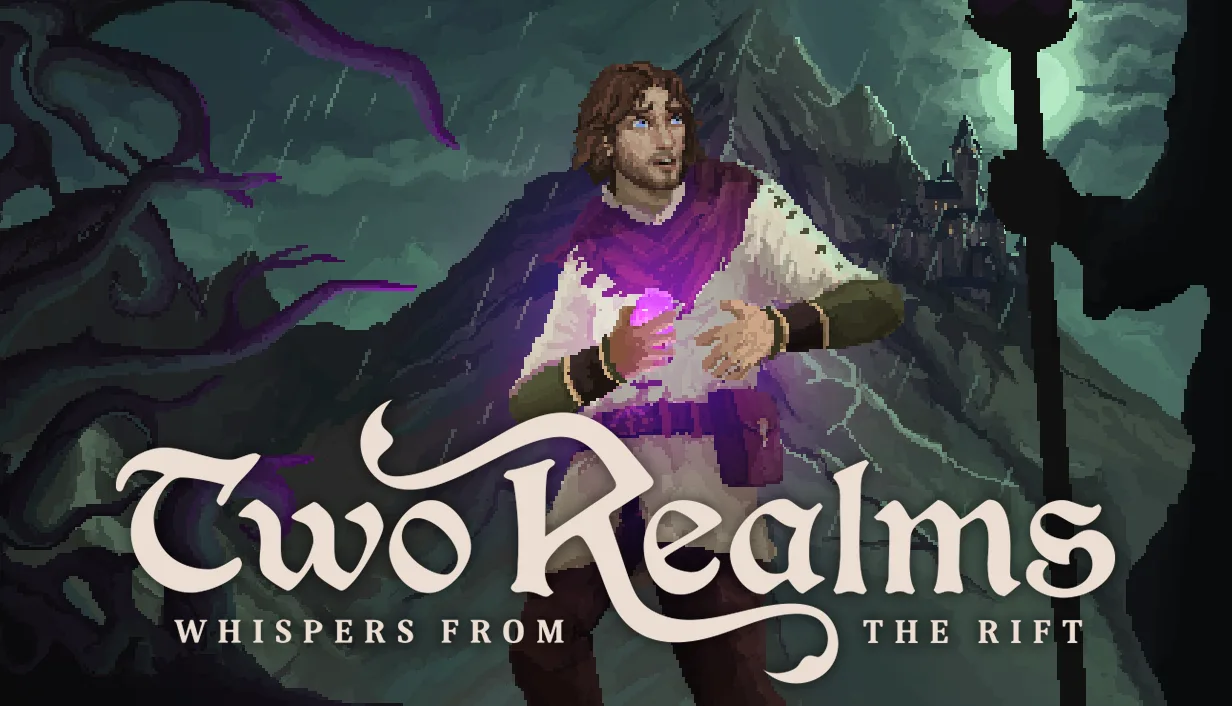
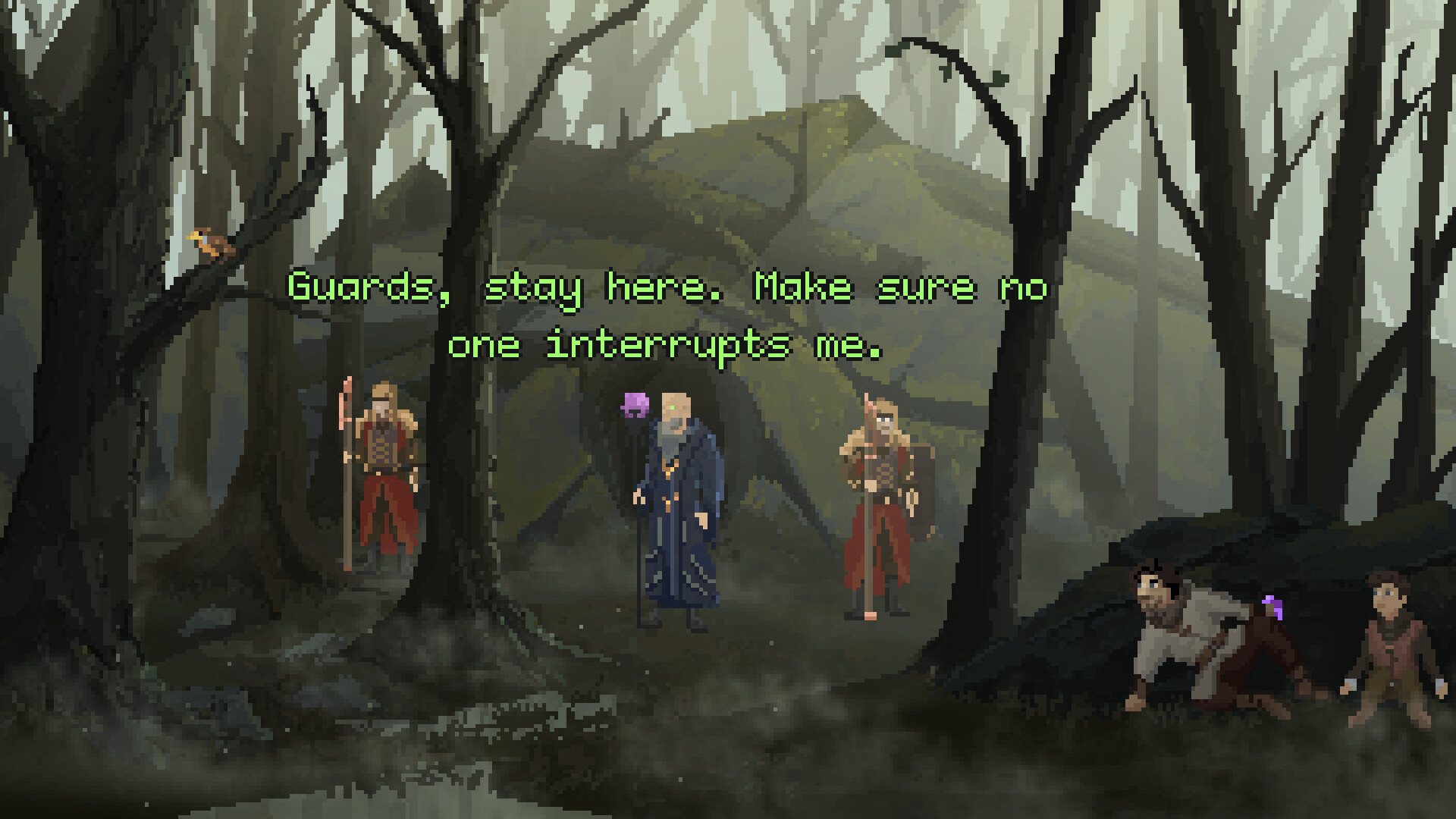
Recently, I had the opportunity to play the demo of the promising Czech pixel-art point-and-click adventure Two Realms: Whispers from the Rift ahead of its release. The game promises a horror atmosphere set in a fantasy world, a more cinematic approach to puzzles, and high-quality voice acting.
The demo, which lasts around 30 minutes, left a very strong impression on me. The pixel-art style is beautiful, the environments are full of atmosphere and very well crafted, and the same can be said about the soundtrack. As for the story, it’s hard to judge from such a short sample. The beginning may feel slightly cliché, but I believe the full version will deliver some surprises. The voice acting goes hand in hand with that, and I found it quite solid, even though one of the characters is voiced by the developer himself.
The puzzles lean towards a more cinematic style and logically tie into the story, similar to what you might know from games by Postmodern Adventures, which I think is the right choice for the overall tone of the game. Overall, the demo made a strong impression on me, and I’m glad that here in the Czech indie scene a game is being developed that could stand alongside titles like The Drifter and others.
That’s why I also took the opportunity to interview Jaromír Janisch, who kindly answered several of my questions about both the demo and the behind-the-scenes development of the game.
However, I recommend playing the demo first, as it is already available on Steam, so you can have the full context before reading the interview.
Could you briefly introduce yourself, your studio, and your upcoming adventure Two Realms: Whispers from the Rift?
I founded MOD42 Studio in January 2025, and we currently have three members. I’m the programmer, Tomáš is the artist, and Martin is the composer. We work really well together and complement each other nicely. The result of our collaboration is the dark point-and-click adventure Two Realms: Whispers from the Rift. You might say the title is long and a bit clunky, but despite all our efforts, we couldn’t come up with anything better :-).
We are currently releasing a playable demo, for which we set the bar quite high. It features professional voice acting, original music for each location, Czech localization, and controller support. Most importantly, we tested whether the game is fun at various conferences, where it passed through the hands of hundreds of players.
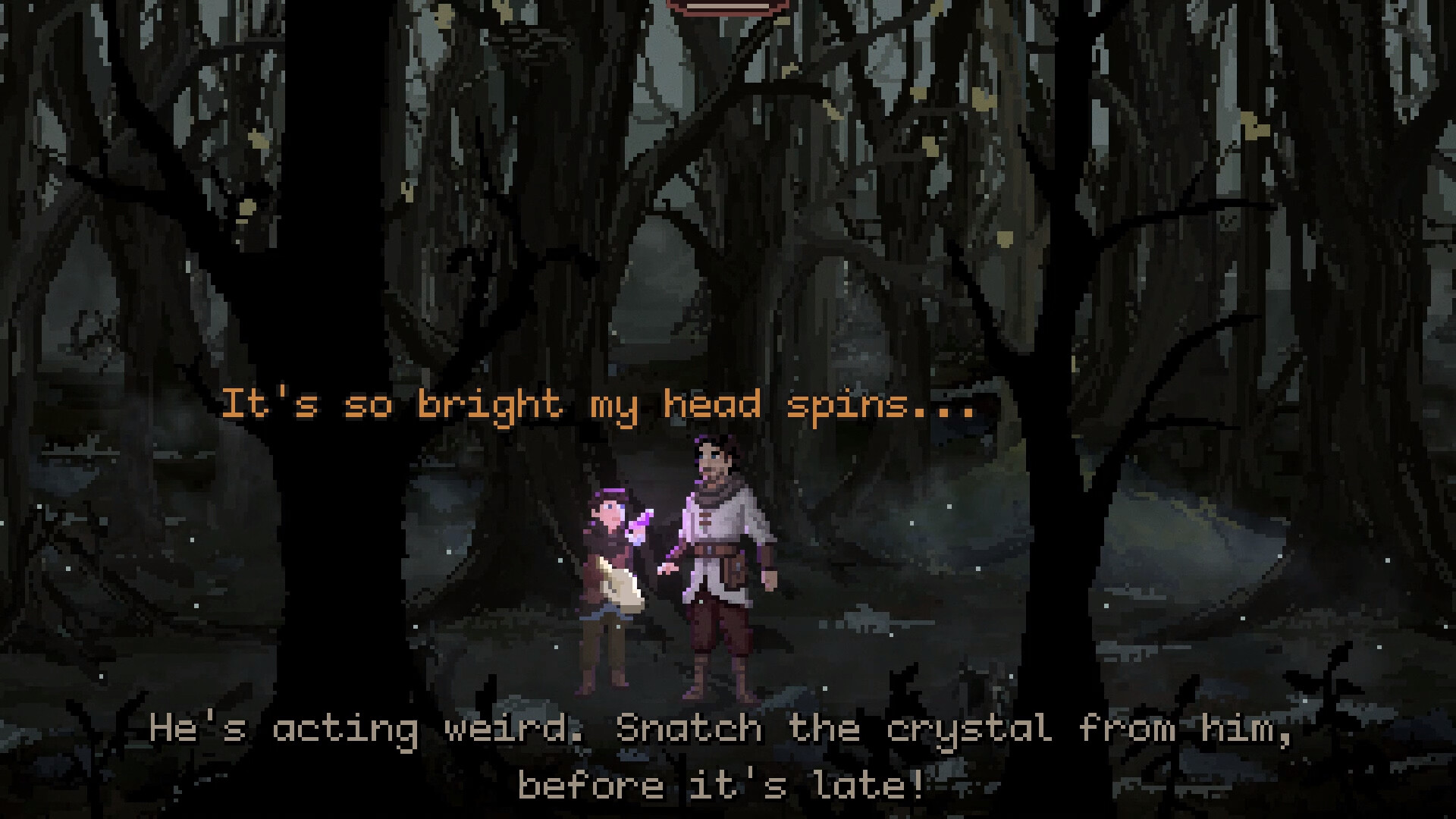
In the game, players follow the story of Tobias and his younger brother Jun, who falls unconscious after encountering a mysterious crystal. Tobias must save him. He sets out for the Citadel in the capital city of the kingdom to search for secret knowledge about magic. However, the ominous mage Thaddeus is on his trail, and Tobias’s sanity begins to deteriorate as he hears voices in his head…
What led you to create a point-and-click adventure? While the genre has been on the rise internationally, it hasn’t seen the same success in the Czech Republic outside of established series like Posel Smrti or Polda. Are you primarily targeting a global audience?
That’s a great question. After some initial calculations, it was clear that no one is going to get rich from this game. I’ll be happy if we at least recoup the time and money invested. Still, I decided to go for it. It’s a passion project for me. I love dark adventures like Posel Smrti, The Excavation of Hob’s Barrow, Kathy Rain, or The Longest Journey, and I felt there simply aren’t enough of them.
Yes, recent years have been very strong for the genre, but it might just be a statistical fluctuation. Naturally, we are targeting the global market, because the game likely wouldn’t be financially viable in the Czech Republic alone. However, I am Czech, the whole studio is Czech, so the game will include Czech, at least in the form of subtitles.
I have to praise the English voice acting in the demo, which I found quite good. Was it difficult to implement? Many pixel-art adventures release without voice acting. How did the process work, and was there ever a plan to release the game without it?
Thank you for the compliment. At first, we considered making the game without voice acting, but after playing recent titles like The Drifter, I felt that good voice acting can significantly enhance the experience.
Initially, we considered using AI, but at several conferences we attended, we quickly learned that this was not the right approach. Not only is it unpopular among players, but AI also lacks the ability to deliver believable emotional performances.
Once we realized that wasn’t the way forward, I started looking for professional voice actors. For the role of Tobias, nearly 50 promising candidates applied, and after a selection process and auditions, I chose Dan Berry. I have to say, he’s excellent. He’s very versatile, understands the character’s emotions perfectly, and his voice fits Tobias really well.
Jun was more challenging. The requirement was for the actor to handle a Northern English accent, which suits the medieval and rural setting (apologies for the stereotype), while also being able to perform a child’s voice, which is more commonly done by female actors. Fewer people applied, so I eventually searched specialized platforms and found Ciara Payne. I can only praise her as well, everything I said about Dan applies to her too :-).
And finally, there’s the mage Thaddeus in the demo, who only has a few lines. Hiring a separate actor felt unnecessary, so I voiced him myself. It’s not bad, but in the full version I’d like him to sound better and more intimidating, so he will likely be recast.
Following up on that, is there any plan for a Czech voice-over in the future?
I would love that, but realistically it would require much more interest from players. At the moment, we don’t see that level of demand. If that changes, a crowdfunding campaign could be an option.
Let’s talk about the game itself. I personally really enjoyed the demo. The pixel art reminded me of games from Wadjet Eye Games, The Drifter, or my favorite studio Postmodern Adventures. The atmosphere and sound design were excellent and fit well with the game’s shift toward fantasy/drama horror. What were your main inspirations in terms of story and visual style?
Ah, thanks for mentioning Postmodern Adventures! They’re somewhat overlooked, but I highly recommend their games Nightmare Frames and An English Haunting :-).
Both Wadjet Eye Games and Postmodern Adventures have this kind of “hard” pixel art style, which is hard to describe. Our game is influenced by the fact that Tomáš, our artist, isn’t primarily a pixel artist but a traditional artist, and pixel art is just a medium for him. He opens Photoshop, grabs a brush, and paints. I absolutely love his style.
Martin is responsible for the music. He’s a very talented composer, winner of the Best Jazz Composition 2023 award from OSA and recognized at the international Composers Summit Prague 2025, among others. And you can definitely hear that in the game.
As for inspiration, I played a lot of tabletop RPGs like Dračí doupě when I was younger, and some ideas may have originated there. That’s where the fantasy elements come from. Atmosphere-wise, I was inspired by games like Posel Smrti, The Excavation of Hob’s Barrow, and more recently The Drifter. I also enjoy detective stories that play with the concept of time naturally unfolding the narrative.
Regarding the horror aspect, how do you approach it, and why did you choose it for what is essentially a story about two brothers? What do you see as the strength of the genre?
I tend to gravitate toward mature themes, dense atmosphere, and darker stories. That’s what I aim to reflect in the “horror” tone. Don’t expect jump scares, but rather a carefully built atmosphere, tension, and a story that puts the player into difficult situations.
Interestingly, the concept of the two brothers came in the second rewrite of the story. It creates a strong motivation. Tobias wants to save his brother and is willing to cross lines he normally wouldn’t.

During the demo, I noticed the puzzles are relatively simple and more cinematic. They make sense, but they’re not particularly challenging. Is this representative of the final difficulty?
We follow a few key principles in our design: no pixel hunting, everything should be logically deducible, and nothing should be frustrating.
You described it well, it’s more of a cinematic approach where the player enjoys the story, and that’s the main goal. The demo represents an average difficulty level, though some moments in the full game may vary slightly.
What is your general approach to difficulty in adventure games? Where do you think the line lies between satisfying challenge and frustration?
There are still fans of the classic nine-verb system from the 90s, but I personally find it frustrating. Why should I have to guess that the correct action is “Open” and use it on a door?
A simplified system uses left and right mouse buttons, one for actions and one for examination. Even Posel Smrti has moments where this is used poorly, for example when you have to right-click a ledge above a door to find a key. That kind of design leads to frustration.
We took a more modern approach and streamlined everything. We use a single contextual action button, and some hotspots are intentionally deactivated. You can’t interact with them, but you can read their descriptions. And instead of generic text like “rock wall,” we describe it more meaningfully, because the player can already see what it is.
This makes the game faster and more accessible. The player doesn’t have to click everything and can focus on what matters most, the story. And even within this system, interesting puzzles can still be created.

Is there something you’re personally most proud of in the game?
I’m very proud of our team, especially how well we complement each other. I give Tomáš and Martin creative freedom, and they repay that by delivering inspiring material that makes my work enjoyable.
I’m also proud of the game itself. Even the demo manages to create a strong and mysterious atmosphere. At conferences, players often ask, “What happens next?” And I tell them, “You’ll have to wait for the full release.”
What stage is the game currently in? Did you encounter any challenges during development?
I enjoy challenges, so problems actually motivate me rather than discourage me. The only things that really stress me are deadlines and marketing.
We’ve spent the last few months focusing on the demo, so I’m glad it’s done. It serves as validation that there is interest in the game.
Now we’re getting back to development, because there’s still a lot of work ahead. The full game is planned for release in 2027.

Thank you for the interview, and we wish you great success with the development of the game!